2025-2026: Bridging the Gap – What Our Grade 8 Literacy Baseline Showed Us and How We’re Responding
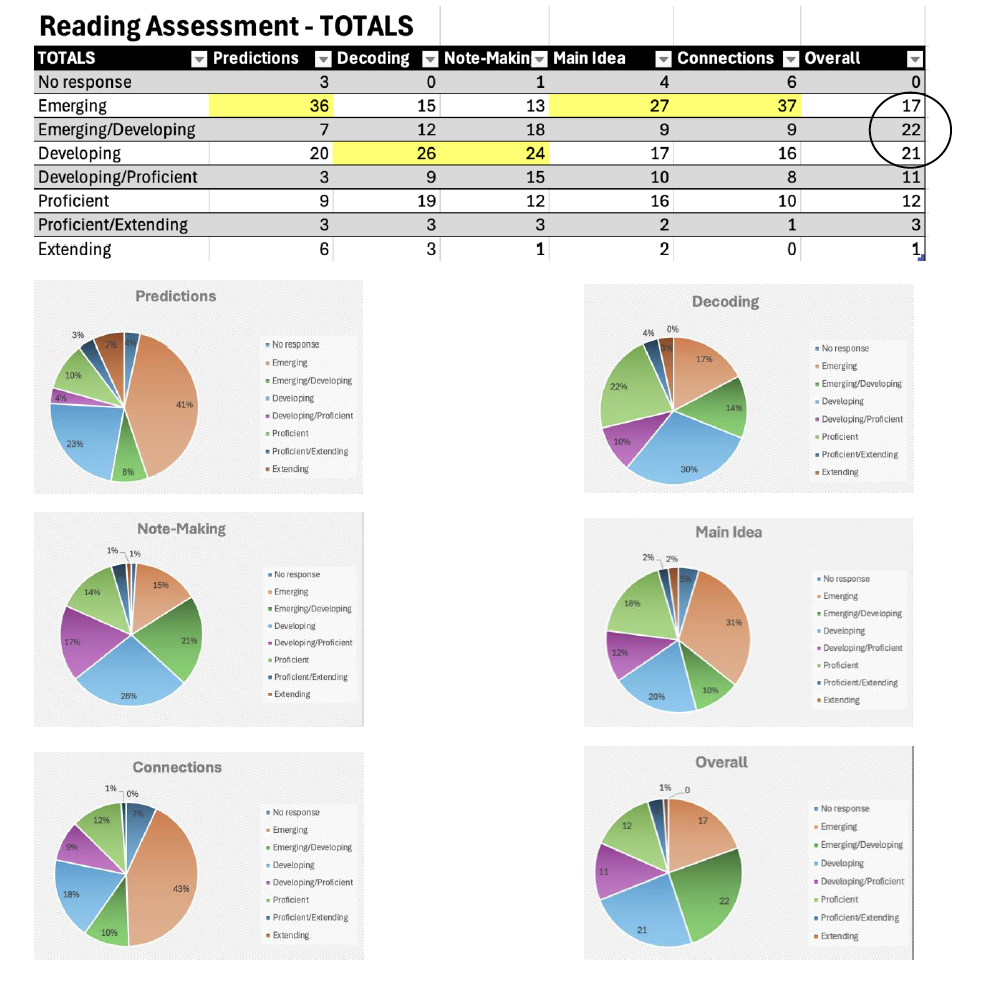
When we finished marking the September 29 literacy assessment, the results spoke for themselves.
Of the 87 Grade 8 students who wrote it:
- About 40% were still in the Emerging category for Making Predictions and Making Connections
- Roughly 30% were Emerging when it came to identifying the Main Idea
- Decoding/Vocabulary and Note-Making also showed large clusters of students who are not yet at the Developing level
But the real story wasn’t just in the pie charts. When marking the student’s actual student work, the same pattern appeared over and over: most students jumped straight into reading or writing without pausing to preview text features (headings, bolded words, images, captions) and without carefully unpacking what the questions were actually asking them to do.
That’s when it clicked—this is less about “reading ability” and more about missing pre-reading habits that help kids approach any new task with intention.
In early October the Grade 8 team met, looked at samples together, and agreed on two straightforward pre-reading strategies that every teacher with Grade 8 classes will explicitly teach and reinforce this fall:
- Following Instructions – slowing down to circle verbs, define what the task is really asking, and talk it through with a partner before starting
- Previewing & Making Predictions – taking a minute to scan titles, subheadings, images, graphs, and bolded words to activate background knowledge and get curious before reading
Stephanie put together clear one-page handouts (see attachment below) for each strategy. They include step-by-step instructions for students, real-life examples (Ikea furniture, driver’s test, job applications), and optional extension ideas. Best part? They require zero extra prep—just a couple of focused minutes at the start of a lesson, quiz, lab, or assignment.
These strategies were shared with the whole staff, and everyone who teaches Grade 8s has committed to weaving them in over the next few months.
This is the Spiral of Inquiry in real time: we scanned with a common baseline assessment, we focused on the clearest area of need (pre-reading habits, and task approach), and now we’re taking consistent, school-wide action.
We’ll keep gathering formative evidence along the way, and when this same group of grade 8s write the parallel assessment in June we’ll be able to measure whether these small habits made a real difference.
For now, the data gave us an honest picture and the whole team is aligned on what to do next.